
The CBSE School Network in the Gulf Is Larger Than Most People Realise
There are over 400 CBSE-affiliated schools operating across the UAE, Saudi Arabia, Qatar, Kuwait, Bahrain, and Oman. Together they serve hundreds of thousands of children of the Indian diaspora — families where education is taken seriously, parental involvement is high, and the expectation for quality teaching and learning outcomes is demanding. These are not small community institutions. Many are large, multi-campus schools with thousands of students, professional leadership teams, and education technology budgets that reflect genuine ambition.
And yet the smart classroom content problem for these schools is surprisingly persistent. The generic international EdTech platforms are not built around CBSE. The enterprise Indian platforms are priced and structured for large government contracts. What a CBSE school principal in Dubai actually needs — curriculum-aligned, subject-wise, grade-wise digital content that a teacher can open on their interactive flat panel tomorrow morning and use for a real lesson without two hours of preparation, is harder to find than it should be.
The Indian school community in the Gulf has grown steadily for decades. With the expansion of Indian professional and skilled-worker communities across all six GCC states, the demand for quality CBSE schooling has grown proportionally. Many of these schools have built impressive campuses, hired experienced faculty, and invested in technology infrastructure. The conversation now is not about whether to go digital, it is about going digital in a way that actually changes what happens in classrooms, rather than simply changing what sits at the front of the room.
When iDream Education has spoken with CBSE school principals and IT coordinators in the Gulf, the conversation follows a pattern that has become familiar. The school has a set of interactive flat panels. They were expensive. The purchase was made with genuine intent to improve teaching quality. And now, months or sometimes years later, the panels are underused, opened for the occasional demonstration lesson or parent observation day, but not embedded in the daily rhythm of teaching. The reason is almost always the same: there is no structured, chapter-aligned content ready to use. The technology is waiting for a content layer that has not arrived.
What iPrep Digital Class Offers CBSE Schools — Specifically
iPrep Digital Class is built on complete NCERT and CBSE curriculum alignment for Classes 1 through 12, all subjects, English medium. It includes animated video lessons for every chapter across every grade, interactive simulations for Science and Mathematics, digital versions of NCERT textbooks, chapter-wise practice question banks with instant feedback, and board examination preparation content for Classes 10 and 12.
For a CBSE school in Abu Dhabi or Riyadh, this means a teacher walks into a smart classroom, connects their pen drive or opens the application on their interactive flat panel, and finds a structured, chapter-wise content library exactly matching what they are teaching that day. The content does not need to be assembled. It is not a general video library that requires curation. It is indexed to the CBSE syllabus by class, subject, and chapter, ready to use.
The platform works on all major interactive flat panel brands including Samsung, LG, ViewSonic, and BenQ. No additional server or network infrastructure is required beyond what most Gulf CBSE schools already have. Setup for a new school is measured in hours, not weeks.
The platform works on all major interactive flat panel brands including Samsung, LG, ViewSonic, and BenQ. No additional server or network infrastructure is required beyond what most Gulf CBSE schools already have. Setup for a new school is measured in hours, not weeks.
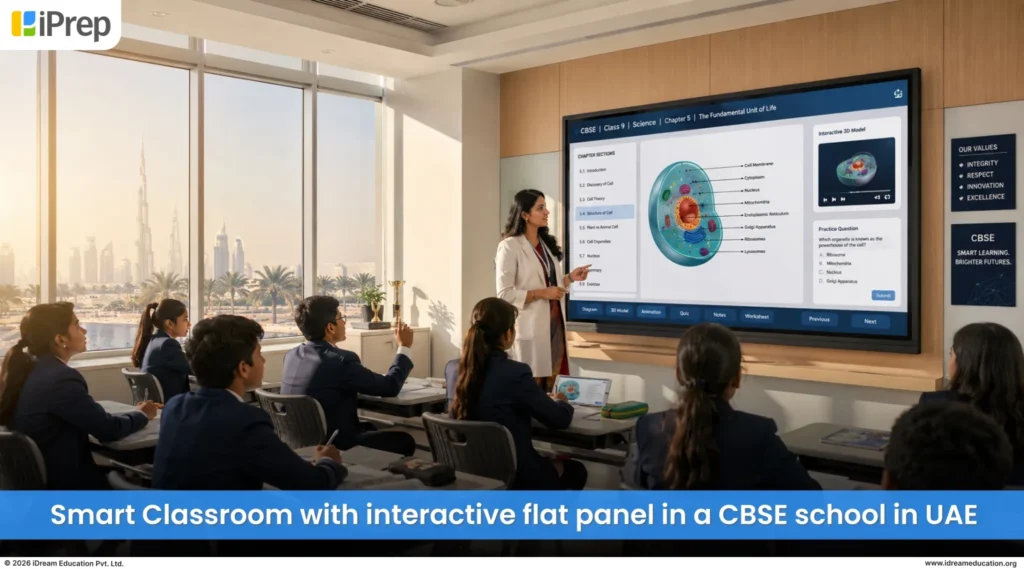
What this means in practice is that a Class 9 Science teacher who has Chapter 5, Fundamental Unit of Life, this week opens iPrep, navigates to their chapter, and finds: a twelve-minute animated video introducing cell structure with high-quality visuals, an interactive simulation for students to explore organelle functions, the NCERT digital textbook open to the relevant pages, a rich-question practice set with explanations for each answer, and a short end-of-lesson assessment. The teacher did not build any of this. They walked in and taught.
iPrep Digital Class is both a supplementary resource library for classroom and in its personalised learning format for students, a primary source for them to learn and develop concept clarity and academic excellence. The content layer that makes an interactive flat panel a genuine teaching instrument rather than a display screen. This distinction matters because it determines how teachers relate to the technology. For teachers interactive tools to improve immediate and long term understanding of concepts by students is a boon, whether or not they have access to seemingly fancy looking hardware and flashy software. It is more about content and less about tech, the latter is an enabler but not the primary driver of what happens within a classroom when it comes to structured interactive learning. Therefore CBSE content for schools in the Middle-east comes as a defining tool for teachers in the classroom and students whether they are studying in a lab in the school or at home on their personal devices. Always ensuring that students are not distracted and either learn offline on iPrep or online but in a moderated learning environment.
The Reading Library — a Feature Gulf Schools Consistently Value
iPrep’s digital book library, over ten thousand English-medium titles spanning fiction, non-fiction, science readers, reference books, self help, biographies of inspiring figures, and age-appropriate chapter books, and thousands of books on varied topics from AI to psychology to history and more, is a feature that Gulf CBSE schools consistently highlight as unexpectedly valuable. Physical library infrastructure in Gulf schools is expensive relative to floor space, and building a meaningful print collection takes years. On iPrep, every student in every class has access to the same library on a tablet or Chromebook. Voluntary reading during free periods is a measurable, reportable behaviour that shows up in engagement data.
For Gulf schools where space is at a premium and per-square-metre costs are significant, the digital library is not a peripheral feature. It is a direct answer to a real infrastructure gap. A school that cannot afford to dedicate a large room to physical books, and cannot maintain a librarian at scale across multiple campuses, gets a complete reading library embedded in the same platform that powers classroom instruction. Students who finish their work early, who have free periods, or who are simply readers by temperament have access to the same breadth of material that a well-resourced physical library would provide.
The biographies and motivational titles in the library are particularly popular in Gulf CBSE school contexts, where parents often have high aspirations for their children and appreciate content that extends beyond curriculum into character and career inspiration. Stories of scientists, entrepreneurs, historical leaders, and social innovators are not separate from the curriculum — they animate it. A student who has read about Homi Bhabha outside class hours brings a different quality of engagement to a physics lesson than one who has not.
Why CBSE Schools in the Gulf Have a Unique Content Challenge
The CBSE content challenge in Gulf schools has dimensions that do not apply in the same way to Indian schools. In India, a CBSE school teacher has access to a wide ecosystem of support: peer networks, local training programmes, district-level resources, and the accumulated culture of the CBSE teaching community. A teacher at a CBSE school in Sharjah or Doha has none of this. They are often professionally isolated, working in a school that may be the only CBSE institution in their emirate, without the informal support structures that Indian teachers take for granted. This challenge is further grave in an environment where learning and physical school is disrupted.
This isolation makes structured digital content even more important in the Gulf context. A teacher in Riyadh who is unsure how to introduce a particularly abstract concept in Class 11 Chemistry cannot ask a colleague down the road who taught the same chapter last week. What they can do is open iPrep and find an animated lesson that presents the concept clearly, a simulation that lets students visualise what is otherwise invisible, and a question set that reveals which students have and have not understood. The content substitutes for some of what the professional community would provide in India.
Additionally, Gulf CBSE schools often serve students whose home environment is more multilingual and more internationally oriented than the average Indian classroom. Students may speak a mix of English, Hindi, regional Indian languages, and Arabic. The common academic thread is English, and iPrep’s English-medium CBSE content aligns directly with that reality. The content is not translated or adapted, it is the same NCERT-aligned content that top CBSE schools in India use, delivered in the medium that Gulf CBSE schools teach in.
