
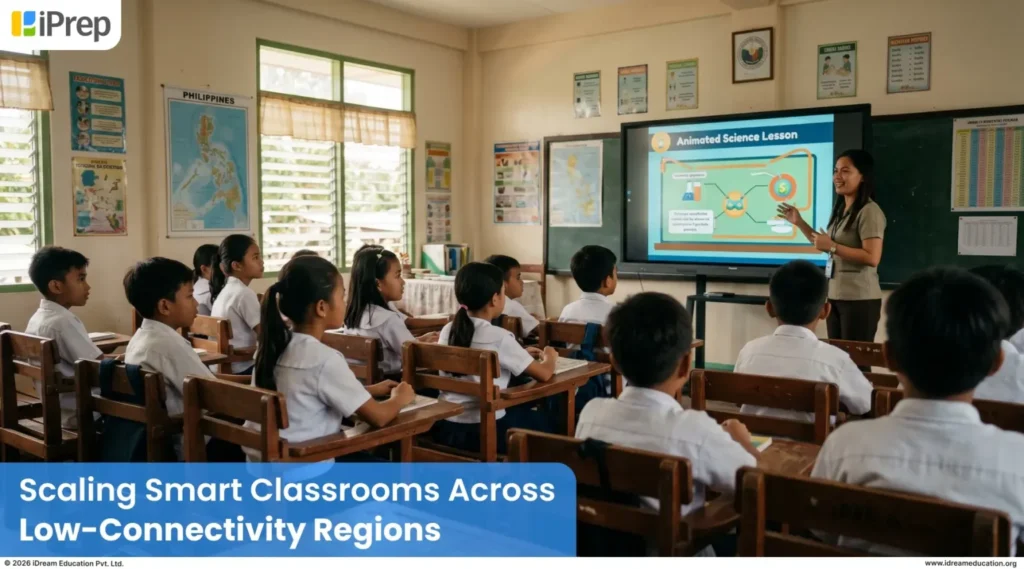
Why Southeast Asia Digital Classrooms Are Growing Rapidly
Across Southeast Asia, the momentum behind digital education has accelerated sharply since 2020. As schools continue investing in smart classrooms and interactive learning environments, solutions such as interactive displays and digital classroom technologies are becoming increasingly important. Educational institutions can also explore our IT and technology services and stay updated with the latest trends through the TechHubX Blog.
Key Challenges Facing Southeast Asia Digital Classrooms
India offers the most directly relevant reference point for this question that exists anywhere. Not because India has solved the problem, it has not, but because India has been running smart classroom programmes in government schools at scale for over fifteen years, in conditions that map closely to what programme managers face in rural Mindanao, or in the outer islands of Indonesia, or in Kampong Cham province.
The similarities are structural. A government school in rural Samar in the Philippines and a government school in rural Jharkhand in India share more in common than either shares with a private school in Manila or Bangalore. Both face: multi-grade classrooms where one teacher handles more than one class level simultaneously; significant absenteeism driven by agricultural calendars, weather, and economic pressure on families; teachers who are formally qualified but practically isolated, without meaningful access to peer support or curriculum resources; textbook shortages that leave students without the basic materials the curriculum assumes; and a testing system that measures recall rather than comprehension, masking learning gaps until they compound into dropout.
What Southeast Asia Digital Classrooms Can Learn from India
Future Opportunities for Southeast Asia Digital Classrooms
iDream works with Aide et Action in India and sets up digital learning with them for the under served students. SE Asia Programme manager at Aide et Action has also echoed the need of expanding PAL in SE Asia. Taking a leaf from what we’ve seen in India with PAL, with iDream itself having some encouraging stories (Half a million students using PAL in a state wide implementation, thousands using PAL with Bharti Foundation, a CSR initiative and a programme implemented in Afghanistan for 40000 students to use PAL on tablets to bridge learning gaps), and the nobel laureate Michael Kremer conducting a study on PAL that found significant impact on improving student learning outcomes, PAL must be expanded to improve the future human
The Teacher Confidence Question
One of the most consistently underestimated challenges in smart classroom deployment is teacher confidence. A teacher who is uncertain about a technology will not use it in front of students, the fear of visible failure in a classroom context is a powerful inhibitor. India’s early smart classroom programmes often made the mistake of treating teacher training as a one-time event: a two-day workshop, a certificate, and the expectation that adoption would follow. It did not. What produced adoption was repeated low-stakes exposure, in-school peer support, and the experience of seeing students respond positively to digital content.
iPrep’s teacher orientation model has been refined through this experience. It is not a training course in the traditional sense. It is a structured introduction to the platform built around concrete classroom scenarios: what does a Class 7 Science lesson look like with iPrep? How does a teacher use the chapter assessment to check understanding at the end of a lesson? What happens if the hardware behaves unexpectedly? Teachers leave orientation with the experience of having taught a simulated lesson, not just having listened to a training presentation.
For Southeast Asian programme partners, this approach to teacher support is directly transferable. The content of the orientation changes, the curriculum, the language, the specific classroom scenarios, but the philosophy does not. Build confidence through doing, not just listening. And build in a mechanism for teachers to support each other, because the most credible advocate for a new teaching tool is always another teacher who has used it successfully.
